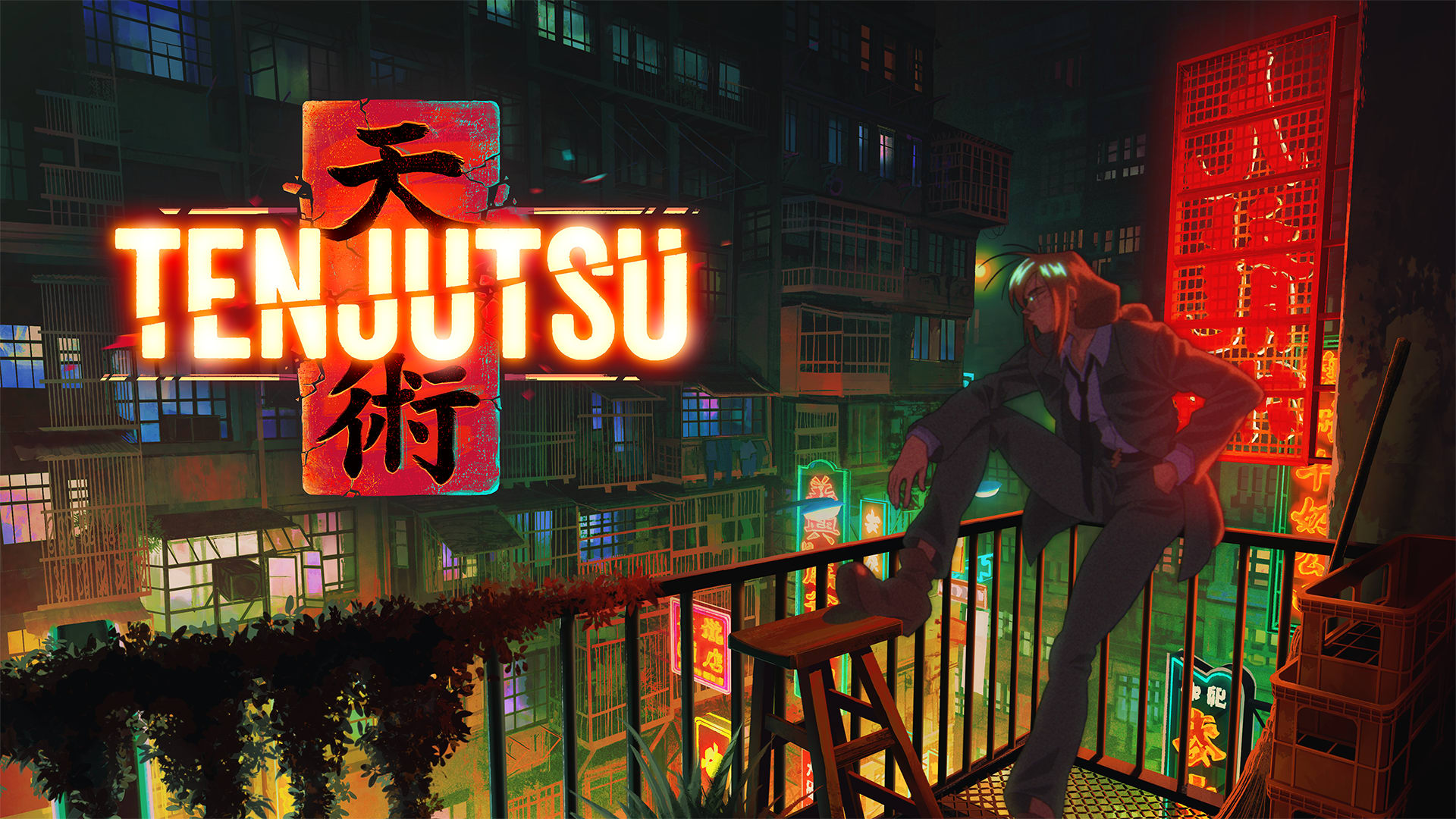
Tenjutsu’s sharpest idea is not only its fast melee combat. The roguelike lets players choose which of four syndicates to attack first, creating a route-planning layer where delay gives the remaining factions time to reinforce.
A city under pressure creates a route-planning problem
Tenjutsu is a combat roguelike set in Secret Garden City, a place controlled by four crime syndicates. Nintendo’s showcase describes the player as a renegade criminal trying to dismantle each faction, and Devolver’s creator materials add a strategic twist: players choose the order of their attacks. The factions that are left alone have time to reinforce their ranks. That makes the map more than a backdrop. Choosing where to go first can change the conditions of later fights.
This is a strong hook because route planning and melee combat ask for different kinds of attention. In a fight, the player reads movement and chooses when to strike. Between fights, they weigh which opponent to challenge now and which one can become more dangerous if ignored. Devolver frames the game as a run-based experience, but the public materials do not explain every reset rule or how a failed run changes the city. The confirmed strategic pressure is enough to make the basic decision interesting without inventing hidden systems.
Four factions can make the same city feel like several challenges
Nintendo says Secret Garden City’s four syndicates each have distinct traits, and Devolver describes players weighing a preferred style against each group’s strengths. That suggests the player is not simply clearing four identical enemy bases. Each faction can demand a different response, though the exact roster and combat behaviors should be checked against future official gameplay. The city’s dense, vibrant presentation also gives those groups a shared place to fight over rather than scattering them across disconnected arenas.
A four-way structure creates a useful question at the start of a run: which matchup feels manageable right now, and which threat should not be allowed to grow? Devolver says attacking one group later gives it time to reinforce. In practical terms, that means players may have to trade an easier opening for a tougher future, or take on a more demanding target early to prevent escalation. We do not know the numerical impact of reinforcements, so the best way to think about it is as a confirmed timing pressure rather than a precise difficulty formula.
Fast melee still asks for deliberate decisions
Devolver describes Tenjutsu as fluid, fast-paced melee combat that demands tactical precision. That combination is important. Fast movement can make a brawler feel energetic, but precision gives those actions meaning. Players are expected to use martial arts, weapons, upgrades, and techniques to break through enemy resistance. The official material does not provide a full move list or control breakdown, so this feature is about the design goal: action should be quick, while the player still has to pay attention to positioning and timing.
This kind of combat is often most satisfying when the player can read a dangerous situation and respond with a clear choice. Do you commit to an attack, reposition, or use a weapon to control space? A roguelike run can amplify that decision because upgrades may change what feels effective. These are general implications of the described system, not claims about a specific optimal combo. When new footage arrives, look for how clearly enemy intent is telegraphed, how the player recovers from mistakes, and whether each weapon changes the rhythm rather than merely raising damage.
The roguelike frame gives experimentation room to breathe
A roguelike structure can encourage players to test an approach, learn from a failed attempt, and build a better plan on the next one. Tenjutsu’s route choice gives that loop a strategic layer before the first punch is thrown. Players can decide which syndicate to surprise, which one to delay, and how their own preferred style fits the matchup. Devolver’s materials explicitly connect faction order to reinforcements, but they do not spell out all run-to-run unlocks or what permanent progression exists.
That uncertainty is not a problem; it is a reason to watch for more details. The design already communicates a clear source of replay value: different orders can create different levels of pressure. If the game lets players adapt their gear and techniques as they move through the city, those choices could form a satisfying loop between combat and planning. Until that is confirmed in more gameplay, it is better to avoid promises about build variety or permanent upgrades. The core pitch is strong enough on its own: learn the city, pick a route, and deal with the consequences.
Secret Garden City gives the action a clear identity
Nintendo calls Secret Garden City a densely packed but vibrant place under the grip of organized crime. Devolver describes a renegade protagonist trying to clear the city and improve life for its residents. That contrast gives the game’s violence a setting and a goal. The city is not presented as a generic arena; it is a community that has been shaped by the syndicates. The player’s campaign is therefore framed as both a personal fight and an effort to change the place around them.
The setting can support variety if each district communicates a different atmosphere or obstacle, but the announced showcase description does not provide a complete map breakdown. We should wait for specific level details before claiming particular biomes, civilians, or side activities. What we can say is that the city premise pairs naturally with the order-of-attack system. A player is not just clearing rooms; they are deciding how to confront a network of rival powers. That makes setting and structure reinforce one another.
The Dead Cells connection is a useful reference, not a promise
Nintendo noted that Tenjutsu comes from the designer of Dead Cells. That gives action fans a quick point of reference for the kind of craft they might expect, especially around responsive combat and repeatable runs. It does not mean Tenjutsu will play like Dead Cells in every way. This game is described as a top-down roguelike brawler centered on martial arts and four syndicates, so it has its own camera, world structure, and strategic focus.
Comparisons can help players decide whether to pay attention, but they should not become a substitute for evaluating the actual game. Watch for how movement feels, whether the weapon choices create distinct options, and if the faction order produces meaningful trade-offs. The developer’s pedigree is an interesting context, while the confirmed design details are the stronger evidence. Players who loved learning enemy patterns and improving through repeated attempts may find Tenjutsu worth following, but the best judgment will come from hands-on footage or a demo if one is announced.
What we know about launch and what to watch next
Nintendo lists Tenjutsu for Nintendo Switch 2 in 2027. The October showcase does not give a precise release date, and the developer’s broader materials focus on gameplay rather than a firm calendar. Check the official game page and storefronts for updates instead of relying on old release windows. The showcased platform is Switch 2; avoid assuming that a particular console or PC version shares the same date until its publisher confirms it.
The most useful future details will be a longer combat demonstration, an explanation of the faction differences, and a look at how reinforcements work across the run. Those answers will show whether route planning is a meaningful strategic system or mainly a narrative wrapper around a brawler. Right now, Tenjutsu has a concise and compelling identity: precise melee, a city controlled by four groups, and a player who decides which fight comes first. For an action game, that is a strong reason to keep it on the radar.
CHECK THE ORIGINALS.
Facts and update details above are based on these official sources. Details can change as the game is updated.
- Tenjutsu Creator Resources ↗Devolver Digital
- New Indie World Showcase features cosy and chaotic fun ↗Nintendo
- Tenjutsu on Steam ↗Devolver Digital
Loading comments…