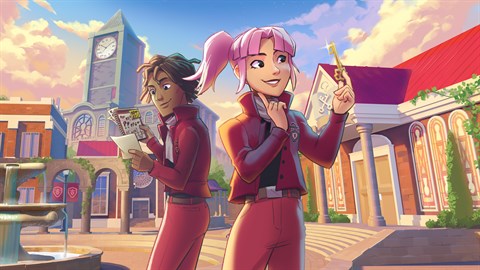
Coin Crew Games is moving from a mostly linear academy to a campus that rewards curiosity between escapes. Its official design notes explain how architecture becomes part of the puzzle.
The sequel changes what counts as a puzzle
Escape Academy 2: Back 2 School is planned for November 5, 2026, and Coin Crew Games has explained a key design shift before launch. The first game moved through a more linear narrative; the sequel expands into an explorable campus. Art director Michelle Huttunen says the school itself should reward curiosity, with puzzles no longer strictly limited to dedicated rooms. That is a meaningful change in structure. A player may start solving something by noticing a building, landmark, or odd detail well before a timer begins inside an escape challenge.
This feature is about the way that design could change the player's attention, not a review of a game that has yet to launch. The official deep dive describes characters, quests, secrets, and reasons to explore between escapes. It does not promise an unlimited open world or reveal the solution to any particular puzzle. The practical appeal is that a campus can turn downtime into discovery. Walking from one challenge to the next becomes part of the experience rather than a neutral loading corridor. Whether that remains exciting across the full game will depend on the density and quality of what players find.
Architecture can carry a clue
Huttunen says the Headmaster's Tower was one of the first spaces the team designed for its updated visual identity. It helped establish what an academic setting should feel like before each campus area developed its own character. The Headmaster's Office also connects to the very first escape in the original game, giving returning players a visual point of reference. That is an elegant way to make a sequel feel familiar without rebuilding the exact same rooms. The building's look can tell part of the school's history before any character explains it.
The Humanities Campus shows this principle more clearly. The team moved away from its earlier 2D-map layout, tried a more open version, found that it initially felt too empty, and then added interactable landmarks, side quests, and escapes. This is a useful design lesson: openness alone is not content. A large plaza needs questions, hints, and reasons to revisit it. Coin Crew's published account says the architecture was adjusted until exploration carried purpose. The final game will show whether the balance feels natural or whether players still chase objective markers past interesting spaces.
The keyhole fountain is a promise of future access
One official example is a keyhole-shaped fountain in the Humanities Campus. Players will glimpse it from elsewhere before gaining access to that area. Huttunen says this is intentional: the school should reveal something interesting before players know how to reach it. That is a familiar but powerful exploration technique. A landmark becomes a question in the player's mind. Later, when a path opens, reaching it feels like answering a question they formed for themselves rather than obeying a task list.
The team also hid keyhole embellishments around the academy. The official post invites players to look for them, but it does not say each one unlocks a reward. That distinction matters. A design motif can build identity, hint at a larger mystery, or simply reward attentive eyes. It does not have to be a collectible counter. If players enter with the mindset that every detail must convert into loot, they may miss the pleasure of noticing how the campus communicates. The sequel seems designed to make observation a habit between rooms, not only during a countdown.
Different campus areas can teach different habits
The official deep dive contrasts the Humanities Campus with the rougher, industrial Science Campus and the colorful Arts Campus. Humanities is meant to feel cozier, leaving room for a coffee break or a quiet discussion even while it holds mysteries. This suggests a school with distinct moods, not just differently colored buildings. A science area might invite technical curiosity, while an arts space might draw attention to visual patterns. Those are inferences from the described identities, not confirmed puzzle categories or a promised order of play.
A campus with distinct zones can also help navigation. If each place has recognizable architecture, players are more likely to remember where they spotted a clue. That memory becomes useful in a game that wants exploration to matter. Huttunen says the sections contain quests and puzzles throughout the journey, but the source does not publish a full map or the number of tasks in each. We should not turn a design interview into an exhaustive guide. What is confirmed is that the team is deliberately using visual identity to make the academy feel like a place, not only a sequence of escape chambers.
Co-op reaches beyond the timed rooms
Coin Crew Games says couch and online co-op are available across the full campus, story, and puzzles. That is important because some puzzle games allow a partner only inside selected challenges, leaving exploration as a solitary wrapper. Here, the intended social experience extends between rooms. Two players can notice different details, debate what a landmark means, and decide together when to enter the next escape. The official description supports the scope of co-op, though it does not specify every platform's cross-play rules or the exact split-screen layout.
Co-op can create a design challenge: one player may see an answer before the other has even understood the question. An explorable campus could give both people room to contribute, but that is an expectation, not a tested verdict. A good shared puzzle lets one person inspect a clue while the other checks a different area, then asks them to combine what they learned. Whether Back 2 School achieves that regularly will need hands-on time. The official promise is broad, and that alone makes it worth watching for players who want a full game night rather than disconnected two-player rooms.
A new student should not need homework
Huttunen says the sequel is open to players who never played the first Escape Academy. That matters because a school mystery full of returning locations could otherwise feel like a private joke. The Headmaster's Office and rebuilt Humanities Campus give veterans familiar references, but the developer's stated goal is a fully realized campus experience for everyone. A newcomer should be able to treat it as a place to learn and explore. That is an intention from the studio, not proof that every story beat will land equally for both groups.
The open structure may help with that onboarding. If players can wander, meet characters, and examine landmarks, they can form their own map of the academy before deeper story reveals. Yet too much freedom can be confusing if the game fails to show what to do next. Coin Crew's account of redesigning an area that initially felt too open suggests the team is aware of this tension. The feature to watch at launch is whether curiosity is rewarded without leaving players lost. Good puzzle design offers enough direction to start thinking, then trusts players to connect the clues.
Why the campus is the headline feature
Escape Academy 2 has obvious selling points: more rooms, a new story, and full local or online co-op. The more interesting confirmed change is structural. Coin Crew wants the journey between escapes to contain puzzles and discovery of its own. The Headmaster's Tower sets the academic identity; Humanities uses landmarks and side quests; a keyhole fountain can be seen before it can be reached. Those examples show a sequel trying to make its setting an active participant in the puzzle, not just a decorative background.
That ambition needs a final game to judge it. A beautiful campus can still feel empty if clues are too obvious or interactions too sparse. But the official design notes give readers a clear question to bring to launch: does the academy make you curious even when you are not in an escape room? If the answer is yes, Back 2 School may offer a satisfying reason to slow down, talk with a friend, and examine every corner before the next bell rings. The promise is exploration with purpose, grounded in what the developers have actually described.
CHECK THE ORIGINALS.
Facts and update details above are based on these official sources. Details can change as the game is updated.
- Escape Academy 2 design deep dive ↗Coin Crew Games / PlayStation.Blog
- Escape Academy 2 Xbox listing ↗Microsoft / iam8bit
Loading comments…