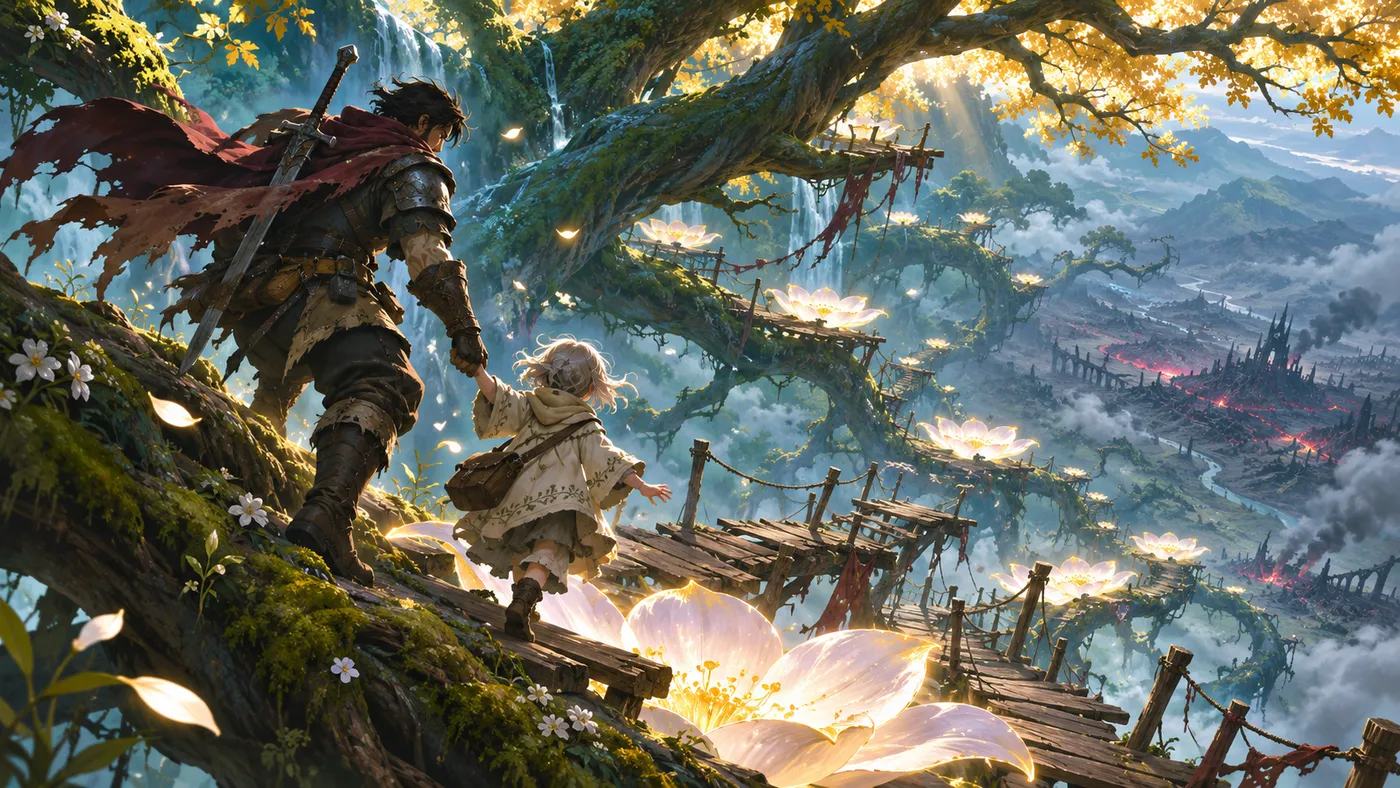
The World Tree rewards a measured descent. Use this spoiler-light planning method to place Flower Dive landings, read unstable platforms and learn from a failed jump.
How do you approach your first descent?
Treat every major drop in Where the Seeds Fall as a landing problem, not simply a jump. Cygames says the World Tree has crumbling platforms and strong winds, while its flower buds can be thrown to create blossoms that absorb a deadly fall. A useful beginner loop is to stop at stable ground, read the route below, place the bud where you intend to land and only then commit. That order gives you a repeatable decision process without revealing a puzzle solution.
We built this guide from CygamesEdge's overview and the official PlayStation and Steam listings. We have not completed a hands-on playtest. The steps here are practical checks readers can try, not claims about exact controls, hidden mechanics or an optimal speedrun line. The game is a single-player action adventure, and the stores describe a short main journey followed by harder maps and time trials. That makes learning a reliable basic route more valuable than guessing at a perfect one on the first attempt.
The safest rule is to separate what you can see from what you hope is true. A wide branch may look safe but be damaged; a flower may look reachable while wind pushes your trajectory sideways. The official description confirms those hazards, but does not give numeric wind strength, bud range or a guaranteed survival radius. Let the game teach you those limits through its own feedback instead of treating an unverified number as a rule.
- Find a stable starting position before studying the next drop.
- Identify the intended landing surface and a possible fallback.
- Watch the wind and consider how it could move you during the fall.
- Throw a bud to create a blossom at the landing point.
- Jump only after the target is visible and the route is clear.
Use Flower Dive as a route-planning tool
The official store pages explain the core action: pick up a bud, throw it toward a target, and use the blossom it creates as a safe landing. That description does not say you can throw unlimited buds or recover a missed one, so beginners should avoid planning around an imaginary stockpile. Think of each bud as a chance to define the next piece of safe ground. The important choice may be where to create the blossom rather than how late to press jump.
Our editorial model has three parts: placement, approach and confirmation. Placement means choosing a surface with enough visible space for the blossom. Approach means taking a line that reaches that spot despite wind and terrain. Confirmation means checking that the blossom actually formed before stepping off. A failure in any one part can look like a bad jump, but the fix will differ. This diagnosis gives a player something specific to change on the next attempt.
Do not assume the farthest possible throw is the best one. A closer, flatter point may give you a stable checkpoint in the route, even if it looks slower. Once you know the level, a farther throw might become useful in time trial. The official pages promise higher-difficulty maps and timed challenges, but they do not publish route maps. Starting with consistency and then testing shortcuts is a sensible progression, not a claim that the game scores you for conservative play.
- Placement error: the bud lands somewhere other than the intended safe area.
- Approach error: your fall misses a correctly placed blossom.
- Confirmation error: you jump before verifying that the landing tool is ready.
- These are reader diagnostics, not named systems from Cygames.
Read wind and damaged platforms before choosing speed
Cygames repeatedly asks players to read the wind and test their footing. That wording matters: wind is part of the navigation challenge, not only decoration around the World Tree. A player who aims straight at the blossom from above may drift away during the fall. Before jumping, compare the target with your current position and notice whether visible particles, vegetation or the character's movement suggest a consistent direction. We cannot guarantee which visual cue the final game uses in every scene, so treat this as an observation exercise.
Crumbling platforms create another reason to pause early rather than late. If your current surface is unstable, planning while standing on it may become the risky choice. First identify the nearest solid-looking place from which to make the next decision. Then look down for a landing that does not require crossing multiple hazards in one uncontrolled movement. The official pages confirm crumbling platforms but do not state their collapse timers. Watch the game's feedback and adapt instead of relying on a fixed countdown from an unverified guide.
Wind can turn a good flower placement into a missed landing, while damaged geometry can remove a launch point. Choose a surface that gives you time to aim, then place the blossom where your fall path seems likely to go. This is a strategy based on the published mechanics, not a measurement of the physics.
Turn a failed jump into one useful observation
When a descent fails, avoid changing every decision on the next try. Pick one cause to investigate: Did the bud miss the surface? Did the flower appear but the character drift away? Did the starting platform collapse before the throw? This is a small troubleshooting loop, but it helps prevent repeated attempts that feel random. It also fits the game's announced structure: a compact campaign can still make players learn precise movement through short, meaningful retries.
If the blossom formed in the wrong place, shorten the throw or choose a wider target. If the character missed a correctly placed blossom, adjust the launch point or wait for a better reading of the wind. If the starting point gave you no time, scout from an earlier branch. These are proposed ways to test a hypothesis, not guarantees that every level offers an alternate launch. The official materials leave checkpoint placement and resource refresh rules unspecified.
Keep the story in view while learning the movement. The soldier escorts a Fell Child toward the Blight-stricken surface; PlayStation says the truth behind the child is revealed during exploration. Racing past every visual detail on the first run may cost you context that makes the descent meaningful. We recommend learning the route and paying attention to the pair's surroundings before focusing on speed. That is an editorial preference, not a score requirement.
- On a retry, change one variable: throw point, launch point or timing.
- Use the visible result of the last attempt to choose that change.
- Check whether the game restores a bud or resets the scene before planning the next move.
- Avoid treating a failed jump as proof that the whole route is wrong.
Build a time-trial route only after a stable clear
CygamesEdge lists higher-difficulty maps and a time trial mode after the roughly three-hour main story. That changes the value of a safe first run. Once you know where blossoms can be placed and which branches are reliable, you can examine where time was lost: aiming for too long, taking extra stops or choosing a landing that leads to a slow next jump. A faster run should remove uncertainty from a route you understand, not replace understanding with blind leaps.
A useful two-pass approach is to establish a clean route, then optimize one segment at a time. On the first pass, note which drops demand careful wind reading and which seem forgiving. On later runs, test a more direct line only at a segment you can repeat. If a shortcut fails often, its theoretical speed may not matter. The official listing confirms time trials, but does not explain scoring, leaderboard rules or whether retries have penalties, so those details must come from the live mode.
Steam lists leaderboards, while its store page also says the game recommends a controller. That may matter to PC players who want consistent inputs, but it does not establish that keyboard is unsuitable or that one controller is objectively faster. Choose the input method you can use accurately and check the game's settings for sensitivity and accessibility. The important goal is repeatable placement, not copying a control scheme from someone else's run.
Why this mechanic makes the game different
Many platforming guides start with a map of fixed ledges. Where the Seeds Fall adds a question before each landing: where should the safe place be created? That shifts part of the difficulty from reaction to route design. A player can improve without merely pressing jump faster; better observation and bud placement may matter more. This is the game's clearest information gain for readers comparing it with a conventional action platformer.
For now, start with the official rule set: unstable ground, strong wind and flowers that catch a fall. Use the five-step descent check above, observe what the game confirms, and return to harder maps or time trials after you have a dependable route. Our linked sources are current product descriptions, and their availability labels can differ by region or update after publication. Nothing here claims a hands-on playtest or a verified fastest route.
FAQ
What is Flower Dive in Where the Seeds Fall?
The official store describes carrying flower buds and throwing them onto a landing spot. The resulting blossom absorbs the impact of a fall that would otherwise be deadly.
Should beginners rush the descent?
Our spoiler-light recommendation is to identify stable ground, note wind and place a flower before committing. This is a planning method derived from the official mechanics, not a tested optimal route.
Is there anything after the main story?
Yes. Cygames and the PlayStation Store list higher-difficulty maps and a time trial mode after a main story estimated at about three hours.
CHECK THE ORIGINALS.
Facts and update details above are based on these official sources. Details can change as the game is updated.
- Where the Seeds Fall official gameplay description ↗PlayStation Store / Cygames
- Where the Seeds Fall Steam page ↗Steam / CygamesEdge
- CygamesEdge release and story overview ↗CygamesEdge
Loading comments…