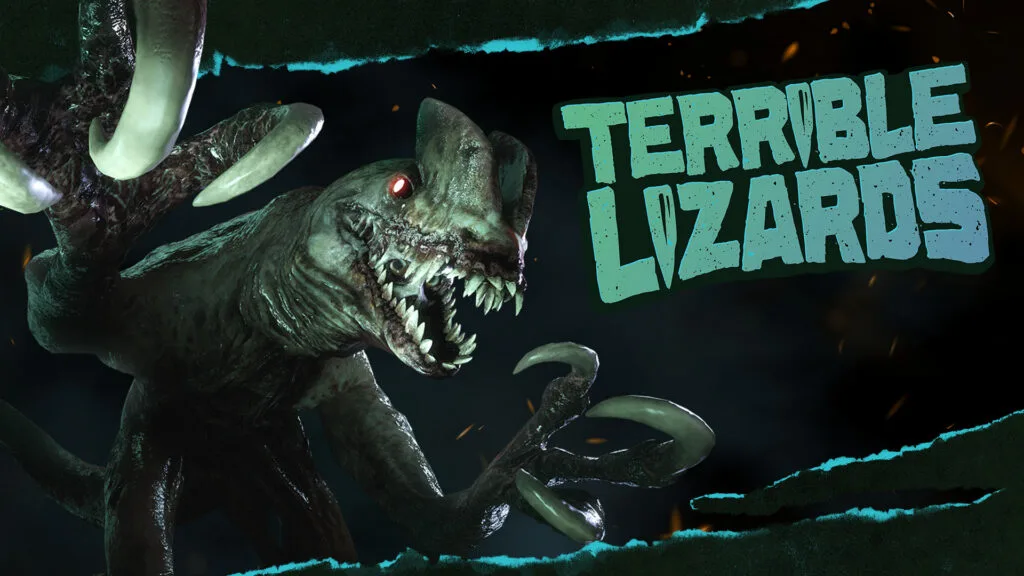
Game director John Gelardi explains how Terrible Lizards combines responsive controls, midair correction and route learning to make every escape feel earned.
The escape is built around how you move
Terrible Lizards is a first-person platformer about fleeing runaway dinosaur animatronics in an abandoned roadside attraction. It is available on Xbox Series X|S and Game Pass, according to game director John Gelardi's October 30 Xbox Wire feature. The setup sounds like horror, but its central verb is movement. You survive by reading a route and keeping your momentum through it, rather than treating every threat as something to defeat in a fight.
Gelardi describes rhythm as the key feeling he wanted. He points to the fast reactions of classic 2D platformers and asks how that response might work in 3D first person. That is a harder problem than it sounds. In first person, the camera hides the full shape of your body, so a player must judge distance, speed and landing space without watching a character's feet from the side. A good control scheme has to make those judgments feel fair.
This feature looks at the official design explanation rather than claiming a personal hands-on review. The director gives enough detail to explain why the game feels distinct on paper: immediate controls, some forgiveness in the air, visible routes and pressure from pursuing animatronics. None of those pieces works alone. The appeal lies in how a player can turn a messy first attempt into a clean run.
- Available on Xbox Series X|S and Game Pass
- First-person platforming under pursuit
- Midair corrections support route learning
Speed works only when the controls answer quickly
Gelardi cites older Mario and Donkey Kong Country games as examples of reactive platforming. They ask players to trust the controls and respond to what appears next. He also mentions modern first-person references such as Mirror's Edge and Dying Light, but says Terrible Lizards aims for a tighter immediate feel closer to responsive shooter movement. Neon White is another reference point for platforming built on controls that already feel good.
That design goal matters because a chase loses energy whenever the player stops to calculate a jump pixel by pixel. If turning, jumping and changing direction respond quickly, the route becomes a sequence of decisions rather than a set of awkward pauses. The game can then ask you to react to a dinosaur's position without making the basic act of moving feel like the enemy. Responsiveness is a foundation, not an optional polish layer.
For a new player, the practical test is simple: take a short route and repeat it. Notice whether the same jump behaves consistently when you enter at a similar speed. Notice whether a quick turn can save a bad approach. If the answer is yes, you can start learning from mistakes. A game built around movement should invite another attempt because you know what to change, not because you hope the controls behave differently next time.
A little air control creates room for mastery
The director says Terrible Lizards lets players adjust their trajectory after jumping. That slight floatiness may sound at odds with tight movement, but it solves an important problem. First-person jumps can be difficult to judge from a single camera angle. A small correction gives a less experienced player time to pull back from an overshoot or shift sideways toward a ledge. The game can remain demanding without making every imperfect launch fatal.
The same freedom can serve skilled players differently. Once you understand the jump arc, midair control becomes a tool for taking sharper lines and preserving speed. A beginner uses it as a safety net; an experienced player uses it to refine a route. That is good mechanical economy. One system supports accessibility and depth without creating separate movement rules for different players.
Do not mistake forgiveness for automatic success. If you jump too late or fail to spot a landing, the game can still punish the decision. The value of correction is that it makes the outcome more connected to what you did. Try practicing one kind of error at a time: overshoot, sideways drift or a rushed turn. When you know which input fixes each problem, a chase becomes less chaotic and more readable.
The attraction is a route, not just a backdrop
An abandoned roadside attraction gives the game a useful visual language. Walkways, barriers and set pieces can guide the eye while animatronics create pressure. In a first-person platformer, environmental clarity is part of difficulty balance. A player needs to recognize where a route continues quickly enough to act. If the world is only detailed and never legible, a chase turns into a camera hunt instead of a movement challenge.
Gelardi's design post focuses on the feel of moving through these spaces. The official article does not publish a complete level map or every dinosaur behavior. That limit is worth respecting. It is tempting to turn a trailer frame into a promise about branching paths or enemy intelligence, but the reliable feature is the movement philosophy the director actually describes. The release itself will show how consistently the levels support that idea.
When you play, scan ahead during safer moments. Look for a platform edge, an obstacle you can clear and the next clear landing. Then keep your attention moving forward instead of staring at the pursuer. The dinosaur is important as pressure, but the route is your solution. This is the same mental shift that makes a good speedrun feel controlled: the player stops reacting to every scare separately and starts reading the whole sequence.
A pursuer changes the meaning of a missed jump
A platforming gap is a spatial problem. Add a chasing animatronic and it becomes a timing problem too. The player must decide whether to take a safer line, make a sharper turn or risk a faster jump. That tension can make a simple stretch of terrain exciting without filling it with enemies. Terrible Lizards' premise gives its movement system a reason to matter beyond completing a course for its own sake.
The dinosaur theme also changes the mood. Animatronics are familiar shapes made slightly wrong: built to entertain, now out of control. They can make a roadside attraction feel unsafe without relying on a conventional combat loop. The official feature describes the escape premise and the first-person design, but does not establish an exact scare count or a specific enemy AI pattern. Those details should be learned from the game, not invented in advance.
If a chase feels overwhelming, slow your preparation rather than your escape. Use a failed attempt to identify one landmark and one action that caused trouble. On the next run, aim to execute that part cleanly. The point is to convert fear into a plan. A movement game becomes satisfying when the player can say, 'I know why I made it this time,' even if the dinosaur still looks intimidating.
Who is this for?
Terrible Lizards is most interesting to players who enjoy improving a route. The director's stated goal connects classic reactive platforming to immediate first-person controls, with midair adjustment making the system easier to grasp and harder to exhaust. The dinosaur attraction supplies atmosphere and urgency. Those ingredients suggest a game where the best moment is not simply reaching the exit, but feeling a run become smoother.
It may be less appealing if you want a slow exploration game or a combat-heavy survival horror. The official description calls it a first-person platformer, and Gelardi repeatedly centers movement. Read that label before deciding what to expect. The game is available now on Xbox Series X|S and Game Pass, so eligible players can assess the feel directly instead of relying only on a trailer's cut of its most dramatic moments.
Give the opening a focused session. Learn how far a jump carries at different speeds, how much you can steer in the air and which visual cues mark the next landing. If those small decisions become enjoyable, the chase is doing its job. If they never click, the premise alone may not change your mind. Either way, the design story is clear: in Terrible Lizards, the most important weapon is knowing where your next step will land.
CHECK THE ORIGINALS.
Facts and update details above are based on these official sources. Details can change as the game is updated.
- Terrible Lizards: Movement Is Your Weapon ↗Game director John Gelardi via Xbox Wire
Loading comments…