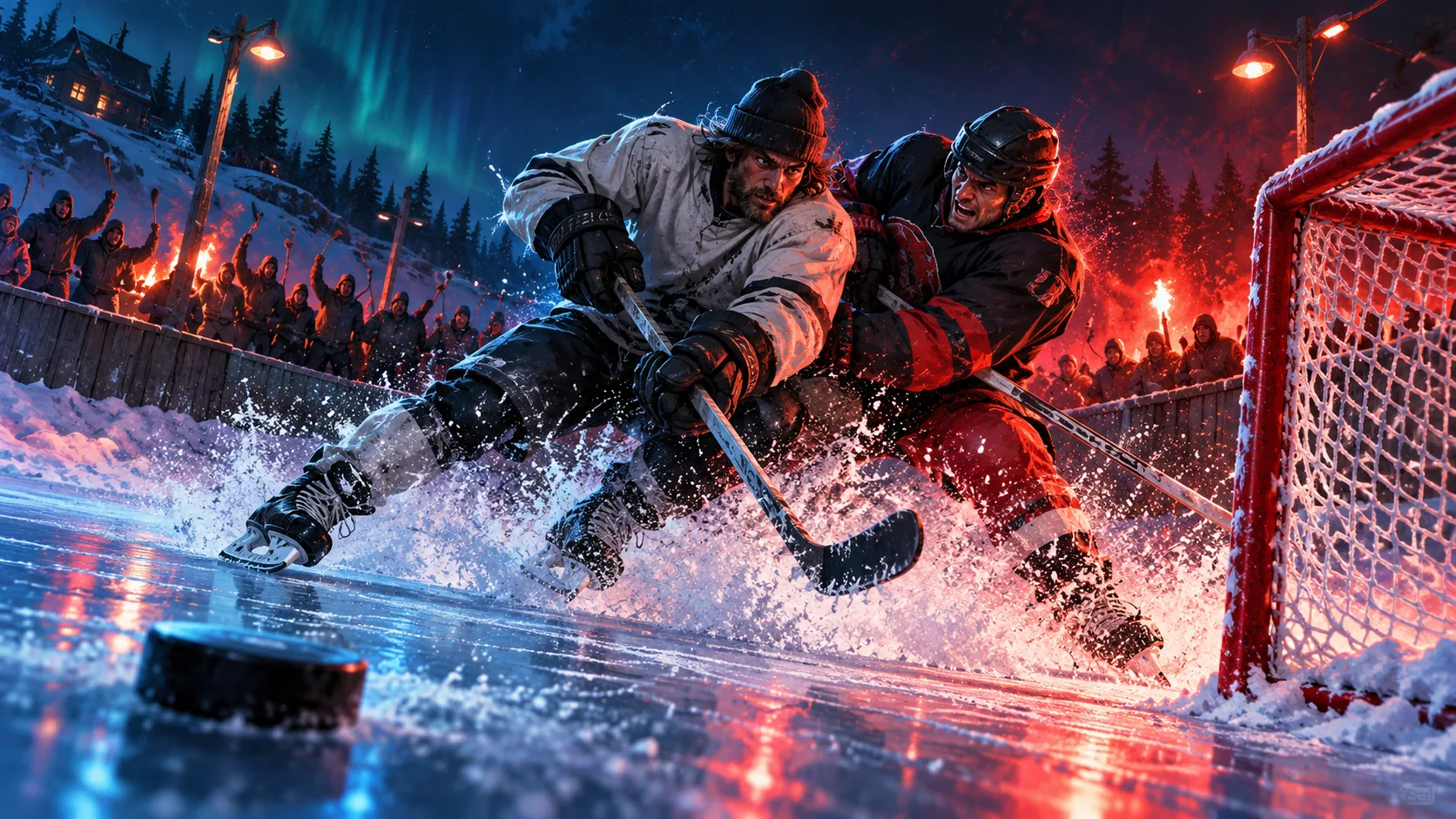
The new Xbox release treats goals as one part of a much stranger hockey journey. Its developer explains the frozen-pond roots, underground rivals and story between matches.
A hockey game that asks for more than a score
Puckoff: Reloaded launched on Xbox Series X|S on October 30, 2026. On paper it is a hockey game, but developer Kuura Playhouse describes an underground sports story where a match can include fights, outrageous takedowns, unusual opponents, and a reason to care what happens next. Scoring still matters. The team's stated ambition is to make it only one possible route to a memorable win.
That is a useful feature angle because sports games often sell realism or a long career ladder. Puckoff makes a different promise: a rough, character-driven trip through a world of improvised hockey culture. The developer's Xbox Wire account supplies the confirmed details here. When we discuss why those details might work together, that is editorial analysis rather than a report of every rule in the finished game.
- 🏒 Hockey matches are part of a wider narrative.
- 🥊 Fights and takedowns can matter alongside goals.
- 📖 Visual-novel-inspired scenes connect the matches.
The frozen pond matters
Producer Marko Haaja says the game's roots lie in the Finnish outdoor rinks and ponds where he played as a child. Those games were spontaneous. Friends turned up, teams changed, and local rules could bend. The studio says many of Puckoff's rinks draw directly from those frozen-pond memories. That background helps explain why the game is not chasing the clean symmetry of a televised professional match.
An outdoor rink can feel more personal than a stadium. It can suggest a place where everyone knows the player who never passes or the goalie who somehow stops every shot. Puckoff builds on that social texture. Its world may be exaggerated, but the underlying fantasy is recognizable: turning a messy game with friends into a legend that people retell later.
This does not mean the game is a simulation of Finnish pond hockey. The developer describes a no-rules take with brutal encounters and a larger fictional narrative. The childhood influence explains the attitude, not a claim of historical accuracy. If you come expecting an official league's exact rulebook, the studio's own pitch should tell you to adjust that expectation.
What changes when goals are not the whole point?
Traditional hockey design puts the puck and net at the center of almost every tactical choice. A player can build skill around skating lanes, passing, shooting, and defense because the scoreboard ultimately decides the match. Puckoff keeps that foundation but opens the door to a more chaotic set of interactions. The developer explicitly asks what happens if winning does not simply mean scoring more goals.
That question can reshape how a match feels. A fight may be a way to interrupt an opponent's momentum. A takedown can turn a safe play into a risky one. A distinctive enemy can require a different plan from an ordinary team. The official post confirms fights and boss-like encounters, but it does not provide a complete competitive rulebook. These are ways to think about the design, not instructions for a guaranteed exploit.
For players, the appeal is variety. The same rink can generate a different story if the opponent pressures the body instead of the puck. That variety only works if the game communicates why a result happened. If a rule feels random, chaos becomes frustration. A no-rules sports game still needs readable feedback, even if it refuses a realistic rule set.
Matches are chapters, not isolated levels
Kuura Playhouse says it wanted a proper story rather than a career mode that simply tracks seasons and upgrades. Between matches, Puckoff uses a visual-novel-inspired presentation to introduce characters, relationships, mysteries, and rivalries. That format can do something a scoreboard cannot: give a name and a motivation to the person waiting across the ice.
The developer centers the journey on Dominator, an underground hockey legend who has apparently gone unbeaten for decades. The player's goal is to find him and eventually play alongside him. Along the way, they meet other figures in this world and prove they belong. The exact story outcomes are for the game to reveal, but the premise gives each match a direction. You are not just climbing a bracket; you are following a rumor.
A sports narrative succeeds when the action and the writing respect each other. If dialogue says a rival is dangerous, their behavior on the rink should help establish that reputation. If a match ends in an unexpected way, the next scene should be able to acknowledge it. The studio's public description does not tell us how reactive every scene is. It does show that the team sees storytelling as the spine of the experience rather than an optional wrapper.
The Cage makes rivals feel like bosses
The most dangerous encounters take place in an underground venue called the Cage. According to the developer, these are boss matches against characters with their own identities, abilities, and ways of playing. The player must get through them to move closer to Dominator. That is a familiar action-game structure placed in an unfamiliar setting: a hockey rink.
A boss can teach players a new interpretation of a game's rules. One opponent might punish reckless attacks; another might make positioning more important than speed. We are describing design possibilities here, not claiming confirmed move lists for Puckoff's cast. The official post is careful about the existence and purpose of the encounters, while leaving detailed strategies for players to discover.
This structure can also solve a pacing problem. A sequence of ordinary matches may blur together, especially in a small indie sports game. A distinct rival gives the player a milestone to remember. The Cage adds a change of tone as well as difficulty: outdoor pond memories become an underground test. That contrast makes the larger journey feel as though it is escalating.
Personality is part of the team sheet
The store description names companions including Sarah, goalie Eddie, and Coach. It also talks about assembling a team of has-beens and legends while learning different playstyles. Those details matter because they put people in the foreground. A teammate can be more than a stat line when the game gives them a recognizable voice or role in the story.
The risk in any character-heavy sports game is that personality becomes decorative. If a teammate is introduced as a clever goalie but plays like everyone else, the fiction and mechanics pull apart. We cannot evaluate that from a store page, and we will not claim every character has a distinct AI system. The confirmed pitch is simply that team-building and character relationships are part of the game alongside the matches.
For a first session, it may be more rewarding to notice what each teammate seems built to do than to rush toward a single optimal lineup. A deliberately scrappy sports story leaves room for strange combinations. Even a player who usually ignores narrative modes might find a memorable character gives them a reason to retry a difficult match.
What a five-person team can choose to emphasize
Haaja says five developers in Finland made the game. Small-team production does not automatically make a game charming, and it does not excuse confusing systems. It does help explain the value of a clear creative priority. Puckoff is not trying to match the licensing, camera work, and statistical depth of a major annual sports release. Its stated focus is the feeling of unruly hockey plus a story about an underground legend.
Visual-novel-style interludes are a practical match for that priority. They can give characters room to speak without requiring every narrative beat to become an expensive cinematic. Distinct arenas and boss opponents can then concentrate the production effort where the player's memory is likely to stick. This is an inference from the described format, not inside knowledge of the team's budget or schedule.
That economy of ideas is why the project deserves a feature rather than a simple launch note. A familiar sport is being used as a stage for character fiction. If the match rules, story scenes, and boss encounters reinforce one another, the result could feel much bigger than its team size suggests.
Who should give it a look?
Puckoff: Reloaded is best approached as an arcade-like, story-driven hockey game. It is for players who enjoy a rough match, colorful rivals, and a sports world that does not ask for realism first. The developer confirms its Xbox Series X|S launch and describes an earlier PC version, but check the current platform store for exact availability, price, and features in your region.
If you try it, judge the first few matches on two questions. Do the collisions and scoring decisions feel legible? And do the characters make you curious about the next opponent? Those answers will tell you more about whether Puckoff is for you than a screenshot of an ice rink. Its strongest promise is that the story between goals matters as much as the goals themselves.
CHECK THE ORIGINALS.
Facts and update details above are based on these official sources. Details can change as the game is updated.
- In Puckoff: Reloaded, Hockey Is About More Than Scoring Goals ↗Xbox Wire / Kuura Playhouse
Loading comments…