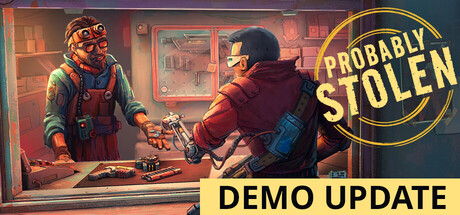
Probably Stolen made the top tier of Steam's October Next Fest demos with a cyberpunk shopkeeping loop built around questionable goods and uneasy customers. Its strongest feature is how each sale can feel like a judgment call rather than a routine transaction.
A shop can be a strong role-playing space
Probably Stolen puts the player behind a small storefront on a divided cyberpunk station. Steam's description frames the game around selling goods, judging customers, and deciding how much risk to accept. That is a familiar setting with an unusual tension: a shop is usually a place to help people find what they need, but here every transaction can carry consequences.
The shopkeeper role gives the player a reason to pay attention to details. Who is asking for an item? What do they seem to want? Is the sale worth the money, or could it damage a relationship with another group? Those questions can turn an ordinary customer interaction into a small story. The game asks players to read situations, not just manage shelves.
The cyberpunk setting helps because a crowded station can make every relationship feel provisional. Customers, factions, and authorities may have different interests, and the player is caught in the middle. That does not require a huge open world to create pressure. A counter, a customer, and a decision can be enough when the game makes the stakes understandable.
Customers become more than a queue of transactions
A typical shop simulator can make customers feel like a repeating source of income. Probably Stolen's description suggests a more uncertain interaction: some customers may be informants, faction contacts, or people testing whether the shopkeeper can be trusted. The player has to decide what each request means, which makes observation part of the economy.
That design can create tension without requiring constant combat. A customer might be valuable because of the money they offer, but accepting the sale could attract attention or change how a faction views you. The decision becomes interesting when the player cannot simply maximize one number. Reputation, access, safety, and profit may pull in different directions.
Good customer systems also need readable feedback. Players should be able to understand why a choice helped or hurt them, even if the outcome is complicated. If a relationship changes, the game should give enough context for the player to connect the result with a decision. That clarity helps a morally gray shop sim feel thoughtful rather than arbitrary.
The inventory loop gives politics a physical form
Steam lists different kinds of work and goods tied to the station economy, including trading and resource-focused roles. That makes the inventory more than a set of icons to sell. What the shop stocks can affect who comes through the door, what conversations become possible, and which parts of the world the player is participating in.
A useful shopkeeping loop asks the player to balance immediate cash with long-term consequences. Paying rent, investing in stock, or holding onto a valuable item can each serve a different goal. If the game lets players make those choices with limited information, each day can feel like a negotiation between the needs of the business and the risks of the station.
Players should watch the costs that are easy to overlook. A profitable sale may require a license, a relationship, or an investment that takes time to recover. The official store page is the best source for the current full-game feature list, while the demo can show which parts of the economy are available to try right now. It is sensible to separate a demo's scope from the complete design pitch.
Reputation can make a small shop feel connected to a larger world
The game description explains that reputation can open access or protection while also making the player a target. That is a strong feature for a shop sim because it gives progress a cost. Becoming known can bring useful customers and opportunities, but attention can also make the shop more vulnerable. Growth is not simply a bar that goes up; it changes the player's position.
Reputation systems work best when different groups care about different things. A choice that earns trust with one faction may create suspicion somewhere else. The player then has to decide which relationship matters for the next goal. This makes a shopkeeper game feel more like a role-playing game without requiring the player to carry a weapon through every conversation.
There is also a natural space for different play styles. One player might try to stay neutral and keep a low profile; another could commit to a faction and accept the risk. The important thing is that the game gives players enough information to understand the trade-offs. Meaningful role-play comes from choices that reflect priorities, not from options that look different but lead to the same result.
The setting can tell its story through the shop's daily routine
A divided space station can feel large without asking the player to walk across every corridor. News, customer requests, changing stock, and faction relationships can make the world visible through the shop. The player experiences the wider conflict in small pieces, filtered through the people who choose to visit and the goods they need.
That approach suits a management game because its interface can become a storytelling tool. A list of stock or a note about rent can explain what has changed, while a familiar customer can show how those changes affect someone directly. The strongest details are the ones that connect the routine of running a business with the larger situation around it.
The game's official description includes jobs and activities beyond a simple register, but the final feature set should be checked on the current Steam page. For players, the demo is a useful way to test the tone and basic loop before relying on promises about a later release. Look for whether decisions feel connected and whether the shop's daily rhythm stays interesting after the novelty fades.
A good management sim makes pressure legible
Shop sims often use time, money, and customer flow to create pressure. Probably Stolen adds suspicion and faction politics to that mix. The challenge is to make each kind of pressure easy to track. If the player can see what is urgent and what can wait, they can make a difficult choice with confidence instead of feeling overwhelmed by hidden timers.
A satisfying session can move through a clear cycle: check the shop's needs, talk to customers, make a few decisions, and see what changes. That structure gives players a reason to keep going while still allowing a natural stopping point. If the game allows multiple strategies, the same routine can feel different depending on whether you are building trust, staying anonymous, or taking a calculated risk.
This is why a short demo can reveal a lot about a management game. It can show whether its interface makes sense, whether customers feel distinct, and whether the first consequences are understandable. It cannot prove that every later system will be equally strong, but it can tell you whether the core loop has enough texture to hold your attention.
Why this cyberpunk shopkeeper game found an audience
Probably Stolen appeared near the top of Steam's official October Next Fest most-played demo chart, which is ranked by unique players. Its store page offers a clear point of difference: a cyberpunk shopkeeper fantasy where selling something can change how people see you. That is a strong pitch for players who want management, narrative choices, and a little tension in the same session.
The game already has a NEXPLAY download profile, so this feature focuses on its design rather than repeating the basic product overview. Check that Steam page for the current launch status, price, demo availability, and requirements. Because the game received updates around launch, verify the latest notes before following any specific economy advice from an older video or post.
The best question to ask is whether you enjoy making decisions with imperfect information. If you like reading customers, weighing a sale against future consequences, and watching a small business become connected to a larger conflict, the concept has a lot to offer. Probably Stolen turns the shop counter into a place where every transaction can move the story a little.
CHECK THE ORIGINALS.
Facts and update details above are based on these official sources. Details can change as the game is updated.
- Probably Stolen — Cyberpunk Shopkeeper Sim ↗Steam / Questing Goose Studio
- Most-played demos of Steam Next Fest: October 2026 Edition ↗Steam
- Probably Stolen Steam announcements ↗Steam Community / Questing Goose Studio
Loading comments…