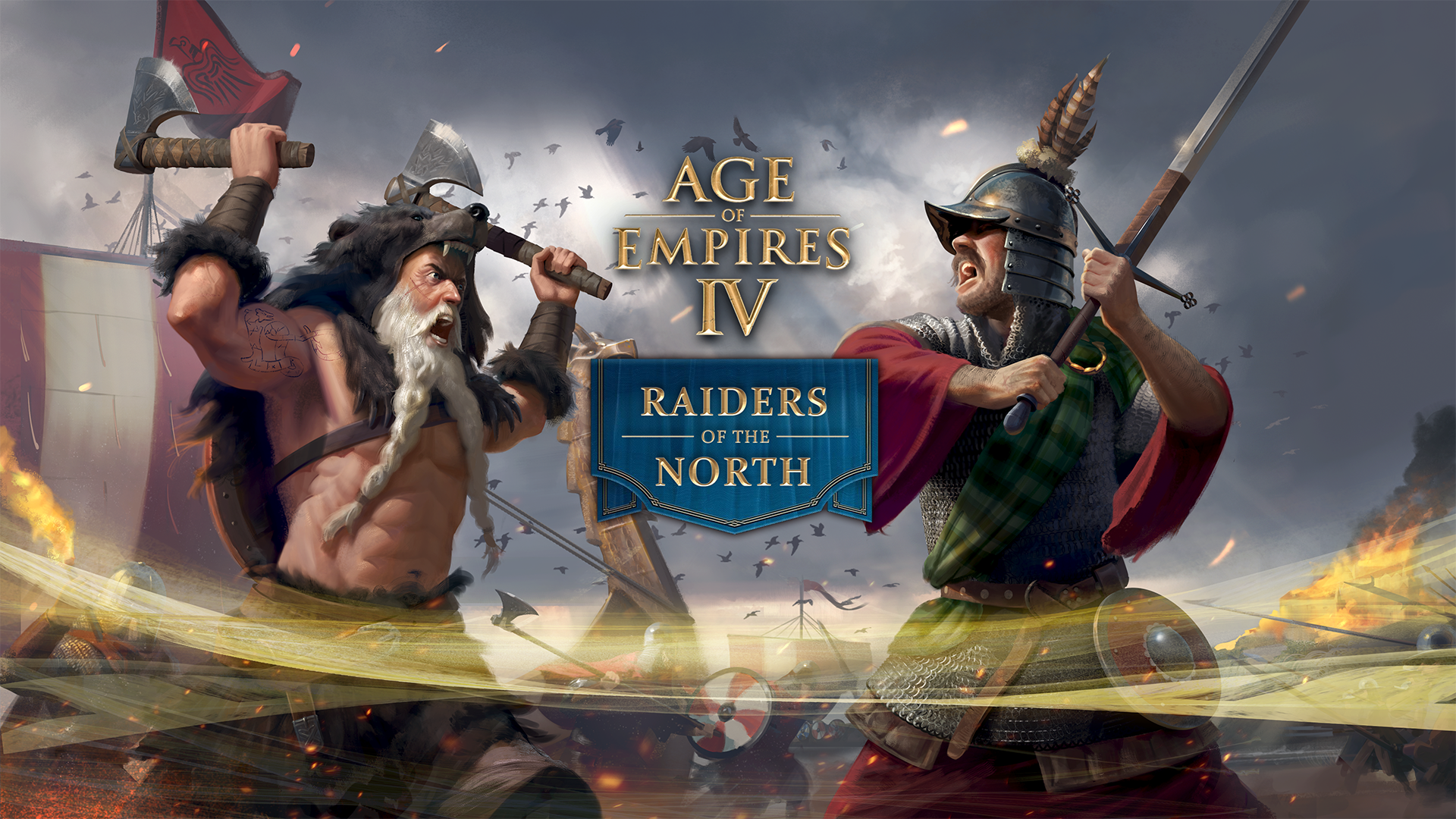
Raiders of the North arrives October 29 with Vikings and Scots, plus an expanded Crucible mode that supports two-player co-op. The official preview points to a clear contrast: Vikings build momentum through raids and a changing civilization, while Scots lean on economy, defenses, and flexible mustering.
Two civilizations, two different strategic rhythms
Age of Empires IV: Raiders of the North is scheduled for October 29, 2026. World’s Edge says the expansion adds the Vikings and Scots, each with distinct mechanics, units, buildings, strategies, and masteries. The official preview presents them as more than two visual themes: their economies and ways of applying pressure are designed to encourage different match rhythms.
The Vikings are framed around raiding, powerful melee infantry, and adaptability. The Scots are described as disciplined and defensive, with a strong food economy and tools for controlling the battlefield. That contrast is useful for understanding the expansion before launch, but it is not a finished balance verdict. Actual strengths, counters, and competitive pick rates will depend on the live patch and player testing.
This feature looks at the announced systems as design choices. It explains what those systems appear to reward, while keeping strategic predictions separate from confirmed facts. A faction description can suggest a playstyle, but it cannot tell us whether a civilization will be easy to learn, difficult to counter, or dominant in ranked matches.
The Vikings are built to turn early movement into momentum
World’s Edge describes the Vikings as a raiding force with fast infantry and strength at sea. Their Longhouse-centered economy is intended to support expansion, while early pressure can help them take the initiative. Those pieces point toward a civilization whose player is encouraged to move outward, contest valuable areas, and make the opponent respond rather than waiting passively.
The Vikings also change as a match progresses. The official preview says their society evolves from the Viking Age into emerging medieval Scandinavian kingdoms, unlocking units such as Knights and Militia Crossbowmen. This creates a progression story within the civilization itself: the army and its options develop alongside the match instead of staying fixed around one early identity.
Heroic Sagas add another layer. World’s Edge says great deeds grant lasting bonuses that can shape strategy throughout the game, while Sacred Groves give players reasons to venture out and contest locations. The precise bonus values and optimal timing are not yet the point of this preview. The clear design signal is that the Vikings are rewarded for taking actions that carry risk and build a longer advantage.
The Scots turn food and fortified ground into staying power
The Scots are described as a resilient civilization built around disciplined infantry, fortified defenses, and a strong food economy. Highland Cattle support continued military production, while Tower Houses and castles help establish a defensive presence. Compared with the Vikings’ emphasis on movement and pressure, the Scots appear designed to hold territory and make an opponent work for every breakthrough.
Their infantry can use stealth forests to create ambush opportunities, according to the official preview. This gives the Scots a way to use terrain actively rather than only building walls around a base. A defensive civilization can still threaten an opponent, especially when the map offers hidden routes or a chance to punish an overextended force.
The Mustering Hall is at the center of the Scottish military approach. It lets players shape forces around Highland or Lowland strengths, giving flexibility while keeping the civilization focused on resilience and battlefield control. World’s Edge has not released every unit statistic, so exact build orders should wait for the game. The concept is enough to show that the Scots’ choices revolve around preparation and holding a favorable position.
The strongest contrast is not aggression versus passivity
It would be too simple to call the Vikings aggressive and the Scots defensive, then stop there. The Vikings need to turn raids into a sustainable economy and a stronger later army. The Scots have stealth-forest infantry and a flexible Mustering Hall, so their defenses can support active plays. Both civilizations have tools to expand and fight; they differ in how their announced systems frame those decisions.
For a Viking player, the interesting question is how long to invest in early pressure before consolidating. For a Scottish player, it is how to use economic stability and defensive terrain to choose the right moment to counterattack. These are design implications, not verified competitive strategies. The release build and match experience will show how quickly each civilization can reach its strengths.
This contrast can also help newcomers choose a first faction. Players who enjoy scouting, moving between objectives, and using opportunities may be drawn to the Vikings. Players who like a stable economy, prepared defenses, and choosing how to assemble an army may prefer the Scots. Those are broad tendencies based on the official descriptions, not guarantees about every match or map.
The Crucible expands the DLC beyond ranked civilization play
Raiders of the North also expands The Crucible, Age of Empires IV’s roguelite-style mode. World’s Edge lists four new missions, deeper progression, and the option to face challenges solo or with a friend in two-player co-op. This gives the expansion a different kind of appeal from its two civilizations: players can cooperate against curated scenarios instead of only testing strategies against an opponent.
The Crucible update adds new objectives, Boons, Perks, Mutators, and civilization-specific Talent Tracks, according to the official preview. Those systems can make repeated missions feel less static by changing what a run asks the player to do and what rewards they build toward. The design goal appears to be replayability through changing constraints and progression, rather than simply repeating a fixed battle.
The official Crucible article also describes two-player co-op, new mission types, and progression revisions. It says players who own either Raiders of the North or Dynasties of the East can access the quick-match queue, while mission ownership affects access to specific missions. Check the current store and official FAQ for exact entitlement rules before buying a DLC to play one particular mode.
What players should watch during the first matches
When the expansion arrives, look for how early access to key systems changes the flow of a match. For the Vikings, test whether movement, raiding, and Heroic Saga bonuses help create a lead that lasts. For the Scots, pay attention to how food income and defensive structures create room to choose an engagement. A few matches across different maps will reveal more than copying one launch-day build.
In The Crucible, compare solo and co-op runs rather than assuming the same mission feels identical with a partner. Two players can share pressure and discuss choices, but cooperation also requires clear coordination. New Boons and Mutators may shift which plans feel reliable from one run to the next. Use the mode’s progression as a reason to experiment instead of trying to solve every mission on the first attempt.
Patch 17.0 includes general balance and quality-of-life work alongside the DLC. World’s Edge notes that saved games and observable matches from previous builds will not load or replay after updating. Competitive players and tournament organizers should preserve anything they need before the patch and review the full release notes. The expansion changes more than faction selection; it arrives within a wider game update.
Why Raiders of the North is a meaningful strategy-game expansion
Raiders of the North gives Age of Empires IV two civilization identities that are easy to explain but have several internal layers. Vikings can raid, evolve, and earn long-term bonuses for deeds; Scots can use a food economy, fortifications, stealth terrain, and the Mustering Hall to shape their force. The Crucible adds a parallel cooperative route for players who want structured challenges.
The expansion’s quality will depend on details the preview cannot settle: balance, mission variety, readability, and whether the two new factions feel distinct in long matches. Those questions belong to player experience after release. The official information provides enough to understand the design direction without declaring a winner before the first competitive season begins.
For returning players, the practical move is to read the complete patch notes, update before launching, and decide whether to begin with a new civilization or a co-op Crucible run. For observers, the contrast between Viking momentum and Scottish resilience should make early matches easy to follow. The DLC is not just adding two names to the roster; it is adding two ways to think about control.
FAQ
When does Raiders of the North release?
World’s Edge lists October 29, 2026, for the Age of Empires IV expansion.
Which civilizations are included?
The expansion adds the Vikings and Scots, each with distinct mechanics, units, buildings, strategies, and masteries.
What is new in The Crucible?
World’s Edge lists four new missions, new objectives and progression systems, and the option to play solo or in two-player co-op.
CHECK THE ORIGINALS.
Facts and update details above are based on these official sources. Details can change as the game is updated.
- Age of Empires IV – Update 17.0 Preview ↗World’s Edge / Age of Empires
- The Crucible Reforged in Age of Empires IV ↗World’s Edge / Age of Empires
- Age of Empires IV: Raiders of the North on Steam ↗World’s Edge / Steam
Loading comments…