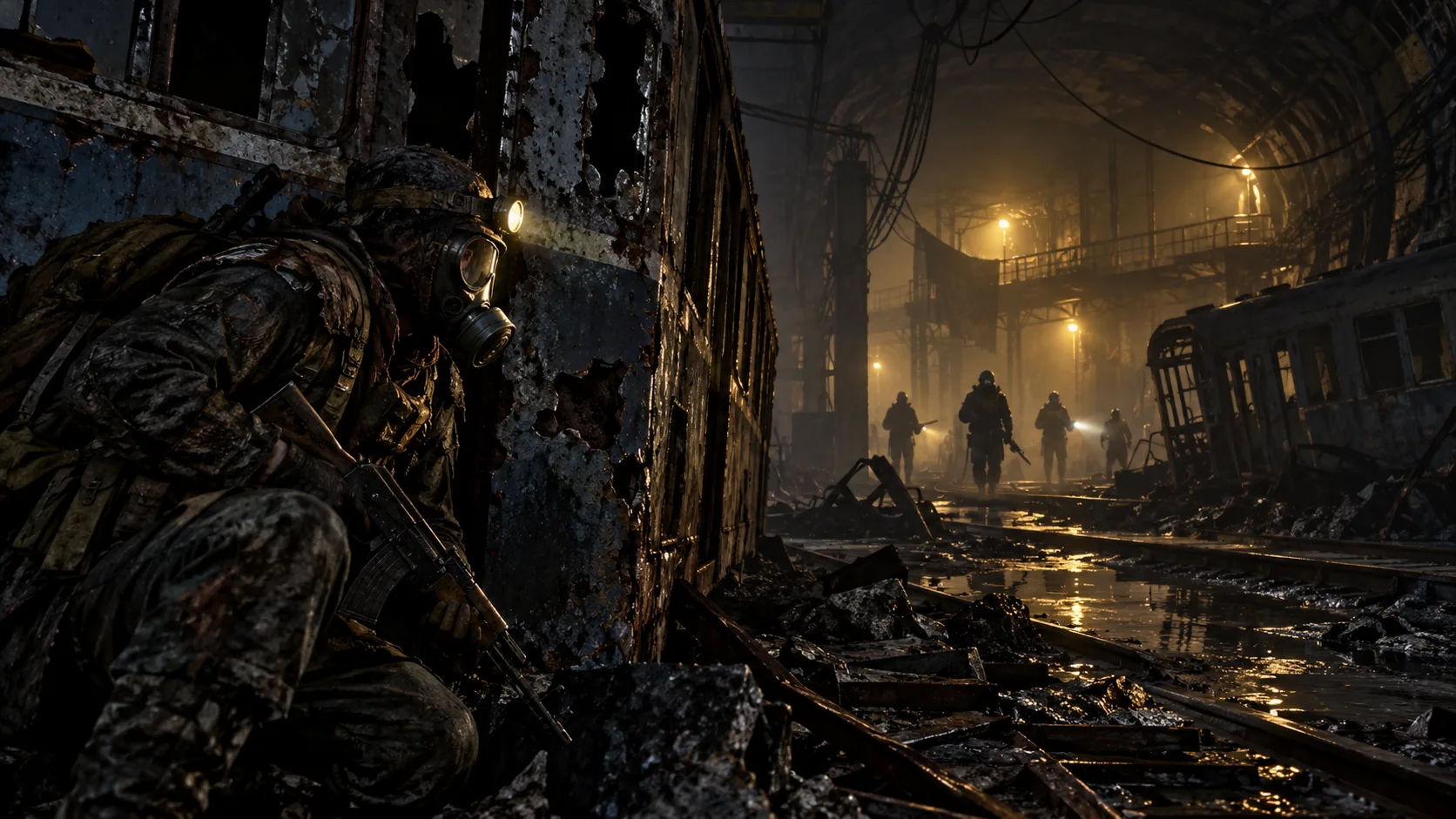
The free Xbox update sharpens both Metro campaigns. Before you head underground, choose a visual mode, understand the two play styles, and make stealth work for you.
The update changes presentation, not your priorities
The free Metro Redux Next-Gen Update arrived on Xbox Series X|S on October 29, 2026. It covers Metro 2033 Redux and Metro: Last Light Redux, adding higher-resolution and frame-rate options, improved textures and lighting, refined animation, and Xbox controller Impulse Trigger feedback. 4A Games says the work was tuned to preserve the original feel. For players, the best first move is still the same: slow down, read the space, and avoid wasting resources.
This guide is written for newcomers and returning players who want a sensible first session after the update. It draws on 4A Games' Xbox Wire breakdown and the official Metro Redux store description. It does not claim to know a perfect route through every chapter. Metro works because each corridor creates a small decision: move quietly, spend supplies, or risk being spotted. The new visuals can help you read those decisions, but they do not make them for you.
- 🎮 Install the free update before choosing a visual mode.
- 🔦 Read the environment before entering a fight.
- 🧰 Save resources for moments you cannot avoid.
Choose the visual mode that helps you play
4A Games says the Xbox update offers true 4K at 60fps or upscaled 4K at 120fps. It also adds 4A TSR upscaling and antialiasing support. These are real options announced by the studio, though your actual display experience depends on the console, screen, and settings. If your television cannot show 120Hz, the higher-frame-rate mode may not give you its full benefit. Check the display's capabilities before changing settings in search of a number it cannot output.
A slower, more deliberate player might prefer the sharper 60fps presentation while scanning dark spaces. Someone who values rapid camera movement may prefer the 120fps option. Neither is automatically the correct way to play Metro. Try the same quiet scene in both modes and notice which makes movement and visibility more comfortable for you. The point is to choose a setting that supports awareness rather than chasing a specification for its own sake.
The update also refreshes textures, lighting, shadows, environment details, and animation. That can make familiar tunnels feel different, especially when a light source reveals or conceals an angle. It does not mean every shadow is a safe place to hide. Use the live game's feedback and enemy behavior as the authority, and treat the visual overhaul as an aid to observation.
Survival or Spartan is a real tone choice
Metro Redux's official store description distinguishes two play styles. Survival leans into a slow-burn horror experience, while Spartan emphasizes the combat skills of a Ranger. The label is not a moral judgment about how someone should play. It is a way to set the amount of pressure and pace you want from these campaigns before a difficult encounter forces the choice on you.
If you are new to the series, choose based on the experience you want rather than what sounds more impressive. Survival encourages caution and makes the wasteland's scarcity feel central. Spartan can be a better fit if you mainly want to learn the story and combat rhythm without turning every fight into a careful accounting exercise. Check the current game's difficulty and mode descriptions because they explain the live options more precisely than any old guide can.
Ranger Mode is another step: the store describes reduced HUD, tougher combat, and limited resources. It can be thrilling once you recognize the game's visual language. It can also hide feedback a first-time player needs. There is no shame in learning the campaign with more information, then returning for a harsher run after you know what a sound or animation means.
Make quiet movement a repeatable habit
Metro's official description calls out intense stealth-action alongside handcrafted weapons, hostile people, mutants, and poisonous environments. A beginner should think of stealth as a sequence of small checks. Before moving into a room, pause and watch a route. Identify a place you can retreat to. Then move one piece of cover at a time instead of committing to a long run because the first few steps looked safe.
The same habit works even when a chapter requires combat. Notice where the threat is coming from, which object blocks sight, and how much space you need to move without becoming trapped. Those are general tactics, not a promise that every level allows a no-alert solution. Metro's atmosphere can tempt you to rush simply to escape the tension. Often the smarter play is to spend another few seconds understanding the room.
Use sound with the picture. A new 120fps mode may make motion smoother, but it cannot replace listening for movement or a change in the environment. Likewise, a prettier shadow does not guarantee an enemy has lost track of you. Let both senses inform the next move. If a plan fails, retry with one change rather than repeatedly sprinting into the same angle.
Treat supplies as decisions, not collectibles
Metro's store description highlights a poisonous surface, a gas mask, improvised weapons, and limited resources in its harder modes. The most useful beginner rule is simple: do not spend something just because you have it. Keep enough supplies to recover from a mistake or handle a section where a quiet approach is not practical. A small reserve can turn a tense late encounter into a manageable one.
That does not mean hoard every item and refuse to use tools. If a supply prevents a dangerous fight or saves a longer route, using it can be the efficient choice. The trick is to ask what problem it solves right now and what you might need before the next safe point. The official material does not give a universal inventory threshold, so any exact number offered without context would be guesswork.
A returning player may remember where resources used to appear. The update is presented as a technical and visual improvement, not a full redesign of each campaign's economy, but it is still worth checking the current build. Interface feedback, mode choice, and difficulty can change how a familiar encounter feels. Play what is in front of you instead of relying entirely on memory from an older console version.
Use the controller feedback as information
The Xbox update adds Impulse Trigger support. 4A Games presents it as a way to deepen the tactile tension of exploring and fighting. The studio does not publish a complete list of every trigger effect in its short announcement, so we will not invent one. What matters for gameplay is whether the feedback helps you notice an action or a change in pressure while your eyes are occupied elsewhere.
Try a short familiar encounter and pay attention to how the controller feels during movement and combat. If the extra feedback helps you read the situation, keep it. If it distracts you or makes play uncomfortable, check the game's and console's accessibility settings for the controls available on your setup. A feature can be impressive and still be a matter of personal preference.
This is especially useful in Metro because the series relies on atmosphere. A controller can reinforce that atmosphere, but clarity should come first. If you cannot tell why an encounter failed, reduce distractions, review the route, and make one deliberate change. Tactile feedback is a tool for attention rather than a substitute for a plan.
Which campaign should you start?
Metro Redux includes both Metro 2033 Redux and Metro: Last Light Redux. A newcomer who cares about the story can begin with Metro 2033 and move into Last Light afterward. That order follows the two-campaign package and makes it easier to understand the world and its people. A returning player can jump back to a favorite chapter to compare the new lighting, frame-rate options, and controls without replaying everything first.
4A Games also says Xbox Ally and Ally X receive optimization and that Xbox Play Anywhere is part of the update. Those platform features are useful if you move between supported devices, but check the live store listing for ownership, installation, and current compatibility terms. The announcement is not a reason to assume every save or configuration behaves identically across every device.
A first session only needs a modest goal: apply the update, choose a presentation mode, pick a play style, and complete a short stretch while watching how stealth and resources interact. By the time you reach the next major encounter, you will have a better idea of which settings feel right for the rest of the journey.
A cleaner view of a dangerous place
The Next-Gen Update gives Metro Redux a sharper, smoother, and more tactile presentation on Xbox Series X|S. It does not erase the reason these games remain tense. The campaigns still ask you to move through a hostile world with limited information and imperfect tools. 4A Games' official notes support the visual and controller changes; the tactics here are a careful way to approach the gameplay they frame.
Choose settings that help you read the world, then trust observation more than speed. When a corridor looks familiar, pause anyway. The improved lighting may show you something you missed before, and the same old discipline can carry you through a version of Metro that feels new without losing its identity.
CHECK THE ORIGINALS.
Facts and update details above are based on these official sources. Details can change as the game is updated.
- Metro Redux Next-Gen Update Out Now for Xbox Series X|S ↗Xbox Wire / 4A Games
- Metro Redux Next-Gen Update FAQ ↗PLAION Support
Loading comments…