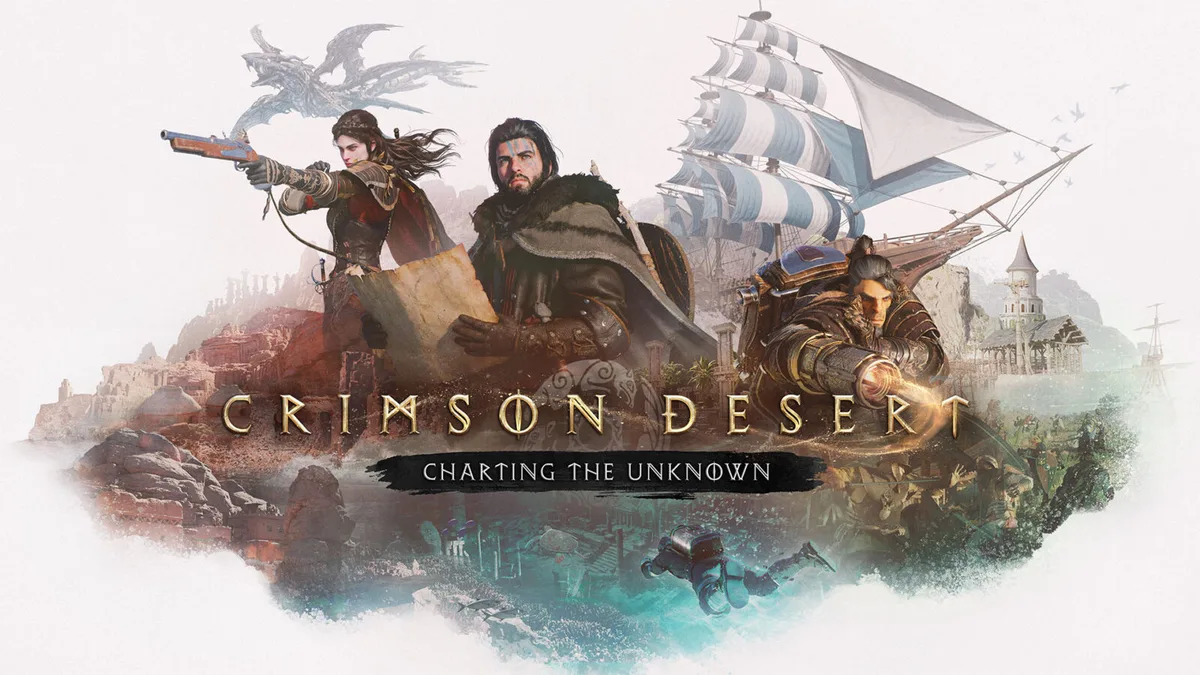
The new DLC offers sea exploration, character stories, housing, and a boss rush. This guide helps you choose a first-session goal without treating every new system as a chore.
Pick one new direction first
Crimson Desert Enhanced: Charting the Unknown arrived on Xbox Series X|S on October 29, 2026, with support for Xbox on PC and Xbox Play Anywhere according to Pearl Abyss. The DLC adds new storylines for Kliff, Oongka, and Damiane, voyages across the Great Ocean, underwater places to explore, stronger housing and castle options, facility management, and Garden of Trials boss challenges. That is a lot to see at once.
This is a first-session guide, not a completion checklist. The developer's Xbox Wire overview is clear about what the expansion adds, but it does not publish an exact optimal route, full boss order, or every crafting recipe. The safest plan is to choose one focus for the evening: follow a character story, learn the sea, build at home, or test combat. You can switch later without trying to master every system on day one.
- 🌊 Take a short first voyage before an ambitious one.
- ⚔️ Treat Garden of Trials as practice with known bosses.
- 🏰 Use housing and facilities to create a home base.
Understand what is new and what came earlier
Pearl Abyss says Crimson Desert launched in March 2026 and received post-launch updates before this DLC. Patch 2.00 in August added story moments and wider voice-over and language support as part of the Enhanced version. Charting the Unknown extends that journey. If you have been away from Pywel for months, update the game and take a little time to remember your controls before heading straight toward the newest content.
The expansion's three new stories are character-specific: Kliff, Oongka, and Damiane each set out on a separate path after the central fight for the Greymanes and Pywel. If one character matters most to you, begin there. That choice gives the session a narrative anchor instead of turning the map into a series of unrelated icons. The official overview describes the stories but does not give a complete quest sequence, so follow the live journal and map for precise access conditions.
A player starting the base game now should avoid assuming the DLC replaces earlier progression. Its new journeys are presented as a continuation. The Xbox post also advertises a limited five-hour free trial of the base game, but trial dates and regional eligibility should be checked on the live store page. A trial is a good way to learn the world; it is not a promise that every DLC storyline is immediately accessible.
Keep the first voyage deliberately short
The biggest change in Charting the Unknown is sea exploration. Pearl Abyss says players can build a ship, sail across Pywel's Great Ocean, dive into underwater areas, discover ruins, open treasure chests, and encounter new creatures and mounts. That sounds like an invitation to push toward the farthest horizon. For your first trip, a nearby route is more useful because it lets you learn ship handling and the return path without tying the whole evening to one unknown destination.
Choose a destination you can identify, note the departure point, and make the first voyage about observation. How does the water change the pace of travel? Which points of interest can be reached without a long detour? Can you comfortably return after a dive or a fight? These are questions to answer in the current game. The developer has not published a universal best ship layout, so this guide does not pretend there is one.
A short route also makes underwater exploration less intimidating. Enter with enough room in your inventory for a find, then return and decide what the new resources are worth to your next plan. There is no need to clear every ruin on a first outing. One successful dive that teaches you how to approach the seabed can be more valuable than a long, messy search for a perfect loot run.
Let the character stories set your pace
The DLC gives Kliff, Oongka, and Damiane new storylines. Pearl Abyss frames them as separate attempts to find a path after the Greymanes' earlier struggle. That is a good reason to play one arc attentively before bouncing between all three. Listen to the setup, learn the people and threats it introduces, and let the plot direct you to a part of the world you might otherwise miss.
Story progress can also help you decide when to take a break from combat. If a quest has just revealed a new location, a shorter exploration session may make the next battle more meaningful. If you are stuck on a difficult fight, use another character's arc or a housing project as a change of rhythm. The official post confirms the stories and new activities; this pacing advice is editorial and does not depend on a claimed hidden unlock order.
The key is to resist the urge to measure the expansion only by how many icons disappear from the map. New stories add context to the world. A route that seems inefficient on paper can be the one that makes a new area feel worth visiting. Give each character's journey some space before turning it into a checklist.
Build a base that supports the adventure
Charting the Unknown expands housing so players can build a home from the ground up and control structural details such as walls, windows, and layout. Pearl Abyss also says certain liberated castles can become personal spaces that can be decorated. These features are easy to dismiss as cosmetic, but a familiar place to return to can make the enormous world feel more manageable.
Start with purpose before decoration. Decide whether you want a compact place to organize activities or a larger project that you will revisit over several sessions. The official material does not specify all storage or convenience mechanics tied to housing, so do not assume an unconfirmed gameplay bonus. The practical benefit you can count on from the announcement is creative control over the look and shape of a home.
Strongholds add another kind of planning. Pearl Abyss says some liberated facilities, such as a restaurant or smithy, can be leased and operated by assigning equipment and comrades, choosing goods, and growing recognition. That is more involved than placing furniture. Try one facility before spreading your attention across every available property. Learning one management loop well is often more satisfying than opening several you cannot keep track of.
Character bonds are a choice, not a timer
Pearl Abyss says Kliff, Oongka, and Damiane can build deeper relationships with some inhabitants of Pywel, potentially leading to romance and marriage. That is a new type of motivation for players who usually follow combat or exploration goals. The overview does not publish a complete relationship chart or exact requirements, so be wary of anyone claiming a guaranteed first-day route to a particular outcome.
Treat new conversations as part of the world instead of a race to fill a progress meter. If you meet someone during a story or sea journey, pay attention to the relationship context and return when the game offers a reason. This is general advice rather than a hidden dialogue solution. The expansion seems designed to make daily life richer, and slowing down can help those interactions feel like more than another reward screen.
Bonds also offer an alternative to constant high-stakes combat. After a difficult boss, a quieter period at home or in a settlement can reset your attention. A large open world benefits from that contrast. You can use it deliberately to keep a long session from becoming exhausting.
Use Garden of Trials to study familiar bosses
Garden of Trials is described as a combat challenge where players face bosses they have encountered during their journey, one after another. That makes it a useful place to test whether your familiar combat habits still hold up under pressure. It is also a reminder that the DLC has activities for players who want a sharper challenge after a period of sailing and building.
Before entering, decide what you want to learn. One attempt might focus on avoiding a particular boss attack; another might test a weapon or ability combination. Do not change every part of your loadout at the same time, or a success will be hard to explain. The official overview does not confirm the exact boss order, reward table, or whether every encounter is available to every save, so check the current game for those details.
If a run ends early, name the problem in plain terms. Was it timing, positioning, resource use, or an unfamiliar boss move? That question turns a failed sequence into practice. A boss rush can be frustrating when treated as a test of worth. It becomes more useful when treated as a controlled place to learn what your build and instincts do under repeated pressure.
An expansion with room for different kinds of play
The strongest first-session plan for Charting the Unknown is to pick a lane and complete a small loop. Sail to one place and return. Follow one character story until it reaches a natural pause. Build one part of a home. Try Garden of Trials with one clear combat goal. Pearl Abyss has confirmed all of these new systems, but no official source says a player should do them in a particular order.
Crimson Desert's appeal is its range: sea journeys, personal stories, strongholds, and tough fights now sit beside one another. The point of a good guide is to make that range approachable, not to shrink it into a rigid checklist. Choose the part of Pywel that sounds exciting tonight, learn its rules, and leave something worth discovering for the next session.
CHECK THE ORIGINALS.
Facts and update details above are based on these official sources. Details can change as the game is updated.
- The Journey of Crimson Desert Continues with Charting the Unknown ↗Xbox Wire / Pearl Abyss
Loading comments…